
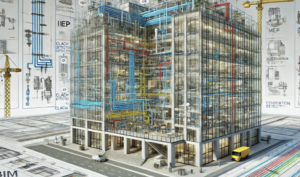
A modern Hotel is not just a building with rooms. It is a tightly choreographed experience that has to work flawlessly from the first day of operations. Guests expect comfort, speed, reliability, and polish. Owners expect predictable budgets, fewer surprises, and an opening date that does not drift. Brands expect standards to be met in every space that touches the guest journey.
That is exactly why 3D BIM Coordination matters so much in hotel projects. It turns an incredibly complex set of design and construction decisions into a coordinated, visual, clash-checked plan that keeps the team aligned before the field becomes the proving ground.
Hotels Are MEP-Heavy Buildings, and Coordination Failures Show Up Fast
Hotels are loaded with systems that must fit together in tight zones: mechanical, electrical, plumbing, fire protection, low-voltage, security, access control, data, audio-visual, and more. Add laundry, kitchens, bars, spas, pools, meeting spaces, fitness centers, elevators, back-of-house corridors, and service shafts, and the ceiling space becomes a high-stakes puzzle.
3D BIM Coordination brings these trades into one coordinated model so conflicts can be resolved digitally instead of being discovered in a hallway ceiling at the worst possible time. When a duct run fights a sprinkler main, or a cable tray blocks access to a valve, the model makes the conflict visible and solvable early. That reduces rework, change orders, schedule hits, and the domino effect that follows when one delay forces every downstream activity to compress.
Guest Experience Depends on Invisible Details BIM Helps Protect
In hospitality, small building issues become big operational issues. Noise transfer. Temperature swings. Poorly routed plumbing that causes pressure problems. Inefficient housekeeping routes. Maintenance access that requires cutting drywall. Technology dead zones that create Wi-Fi complaints. These are not theoretical risks, they are brand-impacting realities.
3D coordination helps teams plan serviceability and operational performance into the building. Access panels land where they can actually be used. Equipment clearances get verified. Risers and shafts get organized so maintenance is faster and less disruptive. The result is a building that works quietly in the background, which is exactly what guests notice when everything feels effortless.
Hotels Cannot Afford Schedule Drift, and BIM Helps Defend the Opening Date
A delayed opening is not just a construction problem. It is lost revenue, staffing disruption, marketing resets, and brand friction. Hotel projects often run on tight windows tied to seasonality, financing, and event calendars. 3D BIM Coordination supports faster decision-making because teams can see the implications of changes, validate constructability, and reduce field-driven redesign.
This becomes even more important as hotel developers push for faster delivery methods and more sophisticated pre-planning. Industry coverage has increasingly pointed toward digital planning, model-driven workflows, and the need to build smarter from day one, especially as owners demand better predictability. One example of hospitality-focused commentary highlighting BIM and data-driven planning is found in Hotelier Middle East.
Brand Standards and Model Rooms Benefit From BIM-Driven Visualization
Hotels live and die by consistency. Brands require standards for room layouts, bathrooms, FF&E coordination, lighting intent, and back-of-house functionality. When teams rely only on 2D documents, subtle misalignments can slip through until they become expensive to correct.
A coordinated 3D model supports virtual reviews that help owners, operators, and brand teams validate the space before it is built. This is especially useful in guestrooms, where repeated layouts multiply the cost of a single mistake across an entire property. Hotel design coverage has pointed to how advanced modeling can influence decisions like whether teams rely on virtual model room experiences versus physical mockups. An example discussion touching this reality appears in CoStar’s hotel design coverage, including the role of BIM software in virtual model room considerations in CoStar.
Renovations, Conversions, and Phased Work Become Manageable With 3D Coordination
Hotels renovate constantly, often while operating. Conversions and adaptive reuse projects add even more risk because existing conditions rarely match old drawings. 3D BIM Coordination is a strong fit here because it creates a reliable coordination environment where existing systems, new systems, and phased sequencing can be planned with fewer unknowns.
With a coordinated model, teams can plan shutdowns, identify tie-in points, reduce surprises behind walls, and maintain guest safety and comfort. For owners, this can mean fewer rooms taken out of service unexpectedly and fewer “discovered” issues that balloon scope midstream.
Prefabrication and Repeatable Rooms Become More Reliable
Hotels are naturally repetitive. That repetition is an advantage when used correctly. Bathroom pods, headwall assemblies, corridor racks, and repeatable riser components all benefit from model-driven coordination. When elements are fabricated off-site or assembled with a high level of precision, coordination errors become far more expensive, because mistakes get reproduced quickly.
3D BIM Coordination helps ensure that what is being fabricated matches what will be installed, with verified clearances and aligned penetrations. Even older industry reporting on hotel construction has pointed to BIM as a driver of faster, more modular approaches to building hotels. A relevant example discussing BIM-enabled construction approaches appears in HospitalityTech.
Energy, Sustainability, and Building Performance Improve With Better Coordination
Hotels have major energy loads and long operating hours, which makes performance a core business issue. Coordination supports performance goals by reducing duct inefficiencies, avoiding routing compromises made in the field, and enabling more intentional planning around mechanical rooms, shafts, and distribution. When coordination is handled early, the design team is not forced into last-minute trade-offs that undermine performance.
This aligns with broader hospitality discussions about smarter buildings and better planning. The more the building can be optimized before it is built, the more control owners have over long-term operating costs and guest comfort.
Digital Twins and Smart Hotel Infrastructure Need Strong BIM Foundations
Hotels are leaning deeper into connected infrastructure, integrated guest tech, and data-informed operations. Digital twins, sensor networks, and building intelligence all rely on accurate building information. A coordinated BIM model supports that foundation by organizing assets, documenting system relationships, and helping stakeholders understand the building as a living operational platform rather than a static as-built drawing set.
Hospitality media continues to spotlight how technology is shaping the built environment and how digital twins are influencing planning and operations. A current example exploring these themes in hospitality design and technology appears in Hospitality Net.
Investor Confidence and Project Risk Management Improve With Clear Coordination
When a hotel project is funded, every stakeholder wants fewer surprises. BIM coordination creates a shared source of truth that helps owners, lenders, and project teams evaluate risk earlier. It supports clearer scopes, fewer RFIs, fewer costly field conflicts, and fewer change orders driven by coordination misses.
In a market where hotel development is influenced by shifting demand patterns, new development narratives, and changing investment logic, disciplined planning matters. Hospitality and travel industry outlets frequently cover how macro forces reshape hotel development decisions, like this example from Skift, which underscores how development strategy and market realities keep evolving. Strong coordination is one of the practical ways teams protect the business case as conditions shift.
A Cleaner Collaboration Process Keeps Designers, Builders, and Operators Aligned
Hotels sit at the intersection of design ambition, operational practicality, and construction reality. 3D BIM Coordination functions as a collaboration tool that helps align those perspectives. Instead of reacting to problems in the field, teams resolve them in coordination meetings where options are visible, measurable, and documented.
This is especially helpful when many stakeholders are involved, including ownership groups, brand reviewers, designers, engineers, general contractors, specialty trades, and hotel operators. The model becomes a common language that reduces misunderstandings and accelerates approvals.
For a broader view of how technology is increasingly embedded in hotel planning and delivery, hotel development coverage such as the technology-focused reporting from TOPHOTELPROJECTS reflects how digital workflows are becoming central to new builds and planning pipelines.
Conclusion
Hotels have a unique challenge: they must open on time, look flawless, operate reliably, and deliver a consistent guest experience from day one. 3D BIM Coordination supports that outcome by reducing conflicts before construction, strengthening schedule certainty, protecting brand standards, improving operational readiness, and creating a stronger foundation for smart building technology.
It is not just a design upgrade. It is a risk-reduction strategy and a performance strategy rolled into one. When the coordination is done well, the hotel runs smoother, maintenance becomes simpler, guest disruptions drop, and the opening date becomes far easier to defend. That is a competitive advantage owners feel in the budget, operators feel in daily performance, and guests feel in comfort and confidence ✅🏨