
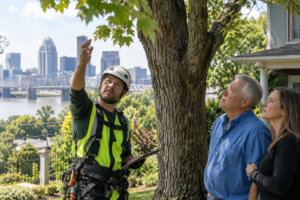
Louisville is known for historic neighborhoods, tree-lined streets, expansive parks, older homes, and properties where mature trees have been part of the landscape for generations. Those trees add character and value to communities across Jefferson County, but they can also create complicated situations when branches cross property lines, roots damage hardscaping, storms bring down limbs, or neighbors disagree about pruning and removal.
For Louisville property owners, tree-related disputes can involve much more than landscaping preferences. Questions of ownership, responsibility, public rights-of-way, tree condition, municipal permits, construction activity, and property boundaries can all become important.
Louisville Metro Government maintains specific rules for trees in public areas, while private-property disputes may involve Kentucky property law and the particular facts surrounding the tree. Understanding those distinctions before cutting, removing, planting, or substantially altering a tree can help property owners avoid unnecessary conflicts and expenses.
Why Tree Law Matters in Louisville
Louisville has a substantial urban forest spread across residential neighborhoods, commercial districts, parks, parkways, and public rights-of-way. Mature trees are especially common in established areas where homes and landscaping may have existed for decades.
Problems often arise because a tree does not necessarily stay neatly within the visual boundaries of one property. A trunk may stand on one parcel while branches stretch across a neighboring roof or yard. Roots can extend beneath fences, driveways, sidewalks, landscaping beds, retaining walls, and neighboring property.
The location of the trunk, property boundary, condition of the tree, and nature of any damage can therefore become important when determining how a particular situation should be handled.
Louisville Metro’s official Urban Forestry division oversees many issues involving trees in public rights-of-way and other areas under Metro jurisdiction. The department provides information about permits, planting, pruning, removal, approved tree species, and local standards.
Property owners facing a more complicated tree or boundary situation can also review information about Tree Law Louisville when professional tree documentation, assessment, or consulting may be relevant.
Property Boundaries Can Be Central to Louisville Tree Disputes
A disagreement about a tree often begins with a disagreement about location.
A fence may look like the property line without actually sitting directly on it. Landscaping installed by previous owners can create another assumed boundary. Mature trees can also grow so large that identifying the relationship between the trunk and the actual surveyed line becomes difficult without documentation.
Before undertaking substantial work on a tree near a neighboring property, owners may benefit from locating an existing property survey or obtaining appropriate professional assistance to determine the boundary accurately.
Photographs can also be valuable. Clear pictures of the trunk, surrounding property, nearby structures, visible deterioration, broken limbs, roots, leaning, cavities, or other concerns create a record of the tree’s condition before any work takes place.
That record may become especially important following a storm, construction project, pruning work, or disagreement between neighboring owners.
Louisville Has Specific Rules for Trees in the Public Right-of-Way
A tree growing in front of a Louisville home is not automatically treated the same way as a tree growing entirely within a private backyard.
Louisville Metro explains that the public right-of-way typically extends from the roadway toward the property line and commonly includes the area between a sidewalk and curb. Where no sidewalk exists, the right-of-way may extend into what appears to be part of a lawn.
According to Louisville’s official Urban Forestry jurisdiction information, property owners are responsible for maintaining trees abutting their property under the city’s Tree Ordinance. The city also directs residents to the LOJIC mapping system when they need help identifying the extent of a public right-of-way.
That makes jurisdiction an important first step before major work begins.
A homeowner may see a tree immediately outside the house and naturally consider it part of the property. The applicable rules can change when the tree is located within Louisville Metro’s public right-of-way.
Louisville Requires Permits for Certain Tree Work
Louisville Metro has established permitting requirements for trees within public rights-of-way.
According to the city’s official tree permitting information, Louisville’s Tree Ordinance requires permits before planting, removing, or pruning trees within a public right-of-way, subject to the city’s stated exceptions for certain routine maintenance.
This requirement is significant for property owners considering substantial pruning or tree removal near a Louisville street.
The city provides a process through Metro311 for requesting planting, pruning, treatment, and removal permits. Urban Forestry personnel can then evaluate the request and determine what requirements apply.
Checking the location and permit requirements before hiring a contractor can prevent situations in which work has already begun on a tree subject to municipal oversight.
Louisville Establishes Standards for Street Trees
Louisville does not treat street-tree planting as simply a matter of choosing a tree from a nursery and placing it wherever space happens to be available.
The city maintains standards governing tree size, spacing, planting locations, and other conditions for trees installed within the public right-of-way.
Louisville Metro’s Standards for Planting Street Trees state that trees planted in the public right-of-way require a permit issued by the Division of Urban Forestry. The standards are designed around appropriate sizing, spacing, and sustainable placement.
These considerations matter because today’s young tree can become a large structure decades later.
A tree planted too close to a street, utility line, driveway, sidewalk, building, or intersection can eventually require extensive pruning or removal. Roots may also affect pavement or other improvements if adequate growing space was not considered from the beginning.
Thoughtful planting can therefore help reduce future disputes and maintenance costs.
Not Every Tree Species Is Approved for Louisville Street Planting
Choosing a species appropriate for Louisville’s urban environment is another important part of responsible tree management.
Louisville Metro maintains a current list of permitted and prohibited trees for public planting areas.
The city’s Permitted and Prohibited Trees list was updated in 2026 and identifies numerous species suitable for particular urban applications while also identifying species that the city does not approve for permitted public planting.
Among the species identified on the permitted list are several varieties of oak, maple, elm, sycamore, redbud, Kentucky coffeetree, baldcypress, and other trees.
Louisville’s guidance states that Urban Forestry will not issue a planting permit when the proposed tree appears on its prohibited planting list.
For property owners, landscapers, developers, and neighborhood groups, checking the approved list before planting within the public right-of-way can prevent unnecessary expense and future replacement.
Tree Condition Can Become Crucial After Damage Occurs
One of the most important issues following a fallen tree or broken limb is the condition of the tree before the incident.
A healthy tree damaged during unusually severe weather can present circumstances different from a tree that had significant visible deterioration before it failed.
Decay, dead branches, cavities, root damage, cracks, leaning, weak branch unions, previous storm damage, and other observable conditions may become important when a dispute develops.
That is where professional tree assessment can provide useful documentation.
An arborist or qualified tree professional can examine the tree and prepare written findings concerning its condition. Photographs and reports made before removal may preserve information that disappears once the tree has been cut apart and hauled away.
Property owners concerned about a potentially hazardous tree near a house, vehicle, neighboring structure, sidewalk, or driveway may benefit from documenting the condition before an emergency occurs.
Louisville’s Mature Tree Canopy Has Broader Community Value
Trees are not merely individual landscape features in Louisville. They collectively form an urban canopy that affects neighborhoods throughout the city.
In September 2026, the University of Louisville reported on an updated urban heat study produced by researchers at UofL’s Christina Lee Brown Envirome Institute in partnership with TreesLouisville. The research examined Louisville’s tree canopy and urban heat conditions and discussed the role of urban greening in reducing heat exposure. University of Louisville’s coverage of the 2026 study provides additional local context.
This broader environmental value is one reason thoughtful tree management matters beyond individual property boundaries.
Mature trees provide shade over streets, homes, sidewalks, and yards. They can influence neighborhood appearance, outdoor comfort, stormwater behavior, habitat, and overall landscape character.
Removing or damaging a mature tree can therefore have effects that extend beyond the immediate location.
Louisville Parks Add Another Layer to Local Tree Management
Louisville’s public park system contains extensive tree resources as well.
Louisville Metro states that Urban Forestry actively maintains trees within Louisville parks and the Parkway System. Its jurisdiction information identifies 119 Louisville parks as part of that responsibility.
That distinction is useful for residents who encounter damaged, leaning, fallen, or potentially dangerous trees near public recreational spaces.
Louisville Metro’s Urban Forestry Frequently Asked Questions explains that the department inspects trees located in parks, parkways, and public rights-of-way on Metro-maintained roads and alleys, while trees entirely within private front or back yards fall outside that inspection responsibility.
Knowing which entity has jurisdiction can save time when a tree problem needs to be reported.
Storms Can Quickly Turn a Tree Issue Into a Property Issue
Louisville experiences thunderstorms, strong winds, heavy rain, winter weather, and other conditions capable of damaging large trees.
Following severe weather, broken limbs can land on homes, fences, garages, cars, sheds, landscaping, and neighboring property. Trees weakened by saturated soil or root damage may also lean or fall.
Safety takes priority when this happens. Trees or branches contacting electrical lines should be treated as potentially dangerous, and unstable trunks or suspended limbs should not be approached unnecessarily.
Once the immediate danger has been addressed, photographs can help document the scene. Property owners may want images showing the entire tree, the point of failure, visible decay or damage, nearby structures, the location where the tree stood, and resulting property damage.
Keeping earlier tree inspection reports, maintenance records, photographs, correspondence, and professional recommendations can add important context if questions later arise regarding the tree’s previous condition.
Construction Can Damage Trees Without Touching the Trunk
Louisville’s established neighborhoods frequently undergo renovation, additions, driveway installation, landscaping improvements, utility work, demolition, and new construction.
These projects can affect neighboring trees in ways that are not immediately obvious.
Tree roots commonly extend far beyond the trunk. Excavation, trenching, grading, soil compaction, changes in drainage, heavy construction equipment, and new pavement can disturb those roots.
A mature tree may continue standing after construction while experiencing gradual decline months or years later.
For significant projects near mature trees, documenting tree condition before construction begins can help establish a clear timeline. Property surveys, photographs, professional assessments, site plans, and written communication with neighboring owners can all provide useful records.
Improper Pruning Can Create Problems Instead of Solving Them
Overhanging branches are one of the most visible causes of neighbor disagreements.
A homeowner may want branches removed because they shade a roof, drop debris, interfere with landscaping, or appear threatening during storms. Large-scale pruning, however, can affect the health and structure of a mature tree.
Removing too much canopy or making poor cuts can create stress, decay, weak regrowth, or structural imbalance.
When a large tree sits close to a property boundary, professional evaluation becomes especially valuable. An experienced tree professional can determine whether pruning is appropriate and how much can be performed without unnecessarily damaging the tree.
For trees located within Louisville’s public right-of-way, municipal requirements must also be considered before significant pruning begins.
Documentation Can Make a Major Difference in Louisville Tree Disputes
Property disagreements become more difficult when everyone involved has a different recollection of what happened.
A basic tree file can provide valuable evidence over time. It may include dated photographs, arborist assessments, invoices, maintenance records, surveys, emails between neighbors, storm photographs, permit records, and written recommendations.
This documentation is especially valuable for large mature trees near property boundaries or structures.
If a dispute eventually involves insurance companies, attorneys, contractors, arborists, or government agencies, contemporaneous documentation can provide a clearer picture than memories alone.
Professional Tree Assessments Can Help Clarify Difficult Situations
Some tree problems require more than routine landscaping knowledge.
Tree condition, structural stability, root damage, construction impacts, decay patterns, species characteristics, and potential failure risks can require specialized evaluation.
A professional assessment can help property owners understand the actual condition of a tree before making an expensive decision.
Professional documentation may also be useful when multiple parties are involved. Rather than relying entirely on competing opinions between neighbors, a written evaluation can identify observable conditions and provide a factual record.
When substantial property damage, ownership issues, or legal claims are involved, property owners may also choose to consult a Kentucky attorney familiar with real estate and property matters. Specific legal responsibility can depend on facts that vary considerably from one situation to another.
Responsible Tree Management Benefits Louisville Neighborhoods
Louisville’s mature trees help define many of its neighborhoods. They shade sidewalks and homes, frame historic properties, soften commercial areas, and contribute to parks and public streets.
Protecting that resource does not mean every tree should remain indefinitely. Trees can become damaged, diseased, structurally compromised, poorly located, or hazardous.
Responsible management means making informed decisions based on location, condition, applicable Louisville regulations, property boundaries, and professional assessment when necessary.
It also means considering the mature size and long-term impact of new trees before they are planted.
Conclusion
Tree law and tree management in Louisville can involve private property rights, neighboring landowners, public rights-of-way, Louisville Metro regulations, storm damage, construction, tree health, and long-term urban planning.
A tree that has quietly grown beside a Louisville home for decades can suddenly become the center of a disagreement after a storm, property sale, construction project, pruning decision, or boundary dispute.
Property owners can reduce uncertainty by confirming property boundaries, documenting tree conditions, checking Louisville Metro jurisdiction, reviewing permit requirements, choosing appropriate tree species, and obtaining professional assistance when circumstances warrant it.
For Kentucky Travel News readers, Louisville’s urban forest represents far more than attractive scenery. Its trees are connected to the city’s neighborhoods, parks, property values, infrastructure, environmental conditions, and quality of life. Careful tree management can help preserve those benefits while giving property owners a clearer path for addressing problems when they arise.